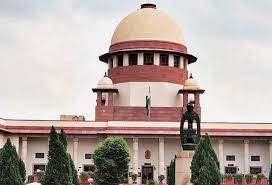
Landmark Judgments: SC & HC Case Law Analysis

Explore our comprehensive repository of pivotal legal rulings. Designed for Judiciary aspirants, UPSC law optional, and legal practitioners, our summaries focus on the ratio decidendi and constitutional significance of each case.

Legal analysis of GAURAV MAGGO  versus THE STATE OF NCT, DELHI
Delhi High Court 29 May 2015

GAURAV MAGGO versus THE STATE OF NCT, DELHI

Section 376 IPC- Sexual Relation on pretext of marriage by Married Man is not a Rape-The woman consents to have a sexual relations with a married man who promises to marry her, continues the relationship and gets impregnated, then it is an act of "promiscuity" on her part and cannot be said as one induced by a misconception of fact and does not amount to Rape.

View Full Analysis
Legal analysis of
Hon'ble Supreme Court of India 27 Apr 2015

The problem with which these appeals are concerned is that many Hindus have changed their religion and have become convert to Islam only for purposes of escaping the consequences of bigamy. For instance, Jitendra Mathur was married to Meena Mathur. He and another Hindu girl embraced Islam. Obviously because Muslim Law permits more than one wife and to the extent of four. But no religion permits deliberate distortions. Much misapprehension prevails about bigamy in Islam. To check the misuse many Islamic countries have codified the personal Law, `Wherein the practice of polygamy has been either totally prohibited or severely restricted. (Syria, Tunisia, Morocco, Pakistan, Iran, the Islamic Republics of the Soviet Union are some of the Muslim countries to be remembered in this context'. But ours is a Secular Democratic Republic. Freedom of religion is the core of our culture. Even the slightest deviation shakes the social fibre. `But religious practices, violative of human rights and dignity and sacerdotal suffocation of essentially civil and material freedoms, are not autonomy but oppression'. Therefore, a unified code is imperative both for protection of the oppressed and promotion of national unity and solidarity. But the first step should be to rationalise the personal law of the minorities to develop religious and cultural amity. The Government would be well advised to entrust the responsibility to the Law Commission which may in consultation with Minorities Commission examine the matter and bring about the comprehensive legislation in keeping with modern day concept of human rights for women.

View Full Analysis
Legal analysis of Carlill v. Carbolic Smoke Ball Co. (1872) 2 QB 484
03 Apr 2015

Carlill v. Carbolic Smoke Ball Co. (1872) 2 QB 484

Carlill v. Carbolic Smoke Ball Co. 1872 2 QB 484 is the important case on the concept of general offer. In the year 1890 an infuenza broke our in the london. The Carbolic Smoke Ball company prepared a medicine called "the carbolic smoke ball" and advertised the reward of 100 to anyone who contacted influenza after having taken the doze three times daily for two weeks. The company deposited sufficient money in the bank to show thier sincerity in the subject matter. A lady Mrs Carlill bought this medicine on the faith of the advertisement and used it in the manner and period specified but even then contacted infuenza. She asked for the money. But when refused she filed a case against the company. It was held that all the essential elements of the contract were present in that case , hence she is entitiled to the amount as mentioned by the company. Held- Although the offer is made to the world, the contract is made with the limited portion of the public who come forward and performed the condition on the faith of the advertisement.

View Full Analysis
Legal analysis of State of Madras v. Champakam Dorairajan AIR 1951 SC 226
Supreme Court of India 03 Apr 2015

State of Madras v. Champakam Dorairajan AIR 1951 SC 226

Mrs Dorairajan file a writ to Hon'ble HC, Madras under article 226 of Contitution of India for fundamental rights u/a 15(1) and u/a 29(2) of the constitution and pleaded to issue madamus. She Prayed she came to know that she would not be able to  take admission in the Madras Medical College as she belonged to the Brahmin community. No, objection was taken to the maintainibility of her petition on the grounds of absence of any actual application of admission made by her. On the contrary, state had agreed to reserve the seat for her, should her application before the HC succeed. In the peculiar circumstances, the court did not consider it necessary to pursue this matter any further. Held- The G.O of the govt was considered to be inconsistent and the provision of article 29(2) in part III of the constitution is void under article 13.

View Full Analysis
Legal analysis of National Legal Services Authority v. Union of India
Supreme Court of India 15 Apr 2014

National Legal Services Authority v. Union of India

Held - "Trans-gender persons" to be persons of "third gender" - (1) Hijras, Eunuchs, apart from binary gender, be treated as “third gender” for the purpose of safeguarding their rights under Part III of our Constitution and the laws made by the Parliament and the State Legislature. (2) Transgender persons’ right to decide their self-identified gender is also upheld and the Centre and State Governments are directed to grant legal recognition of their gender identity such as male, female or as third gender.  We direct the Centre and the State Governments to take steps to treat them as socially and educationally 110 backward classes of citizens and extend all kinds of reservation in cases of admission in educational institutions and for public appointments. (4) Centre and State Governments are directed to operate separate HIV Sero-survellance Centres since Hijras/ Transgenders face several sexual health issues. (5) Centre and State Governments should seriously address the problems being faced by Hijras/Transgenders such as fear, shame, gender dysphoria, social pressure, depression, suicidal tendencies, social stigma, etc. and any insistence for SRS for declaring one’s gender is immoral and illegal. (6) Centre and State Governments should take proper measures to provide medical care to TGs in the hospitals and also provide them separate public toilets and other facilities. (7) Centre and State Governments should also take steps for framing various social welfare schemes for their betterment. (8) Centre and State Governments should take steps to create public awareness so that TGs will feel that they are also part and parcel of the social life and be not treated as untouchables. (9) Centre and the State Governments should also take measures to regain their respect and place in the society which once they enjoyed in our cultural and social life. 

View Full Analysis
Legal analysis of Indra Sarma  Versus V.K.V. Sarma , New Delhi, November 26, 2013
SUPREME COURT OF INDIA 26 Nov 2013

Indra Sarma Versus V.K.V. Sarma , New Delhi, November 26, 2013

  •   Live-in or marriage like relationship is neither a  crime  nor  a  sin though socially unacceptable in this country.   The  decision  to  marry  or not to marry or to have a heterosexual relationship is  intensely  personal.
  •   We are, in this case, concerned with the question whether  a  “live-in relationship” would amount to a “relationship in  the  nature  of  marriage” falling within the definition of “domestic relationship” under Section  2(f) of the Protection of Women from Domestic Violence Act, 2005 (for short  “the DV Act”) and the disruption of such a relationship by failure to maintain  a women involved in such a relationship amounts to “domestic violence”  within the meaning of Section 3 of the DV Act.
View Full Analysis
Legal analysis of Indra Sarma vs V.K.V.Sarma on 26 November, 2013
SUPREME COURT OF INDIA 26 Nov 2013

Indra Sarma vs V.K.V.Sarma on 26 November, 2013

All live-in- relationships are not relationships in the nature of marriage. Live-in partners not entitled to protection if one of the partner has a subsisting marriage
View Full Analysis
Legal analysis of Dayal Singh & Ors. Versus State of Uttaranchal
Supreme Court of India 03 Aug 2012

Dayal Singh & Ors. Versus State of Uttaranchal

In this important case Hon'ble decided three important issue -

  1.  Where acts of omission and commission, deliberate  or  otherwise,  are committed by the investigating agency or other significant  witnesses instrumental in proving the offence, what approach,  in  appreciation of evidence, should be adopted?

  2. Depending upon the answer to the  above,  what  directions  should  be issued by the courts of competent jurisdiction?

  3. Whenever there is some conflict in the eye-witness version  of  events and the medical evidence, what effect will it have on the case of the prosecution and what would be the manner in which  the  Court  should appreciate such evidence?

HELD- WHERE THERE IS AN INCONSISTENCY WITH MEDICAL EVIDENCE (POST MORTEM) AND EYE WITNESS, THE RELIABLE TESTIMONY OF EYE WITNESS SHALL PREVIAL - REFER PARA 11 AND 12 OF JUDGMENT

View Full Analysis
Legal analysis of Bhagwan Dass versus State (NCT) of Delhi dated 09/05/2011
Supreme Court of India 09 May 2011

Bhagwan Dass versus State (NCT) of Delhi dated 09/05/2011

Honour Killing comes within the purview of rarest of the case, so deserve death penalty.

View Full Analysis
Legal analysis of T.M.A Pai Foundation & Ors vs State Of Karnataka & Ors on 31 October, 2002
SUPREME COURT OF INDIA 31 Oct 2010

T.M.A Pai Foundation & Ors vs State Of Karnataka & Ors on 31 October, 2002

WHAT ARE MINORITY INSTITUTION- REQUIREMENT TO ESTABLISH MINORITY INSTITUTIONS- All citizens have a right to establish and administer educational institutions under Articles 19(1)(g) and 26, but this right is subject to the provisions of Articles 19(6) and 26(a). However, minority institutions will have a right to admit students belonging to the minority group.

View Full Analysis